
Real Estate Client Case Study
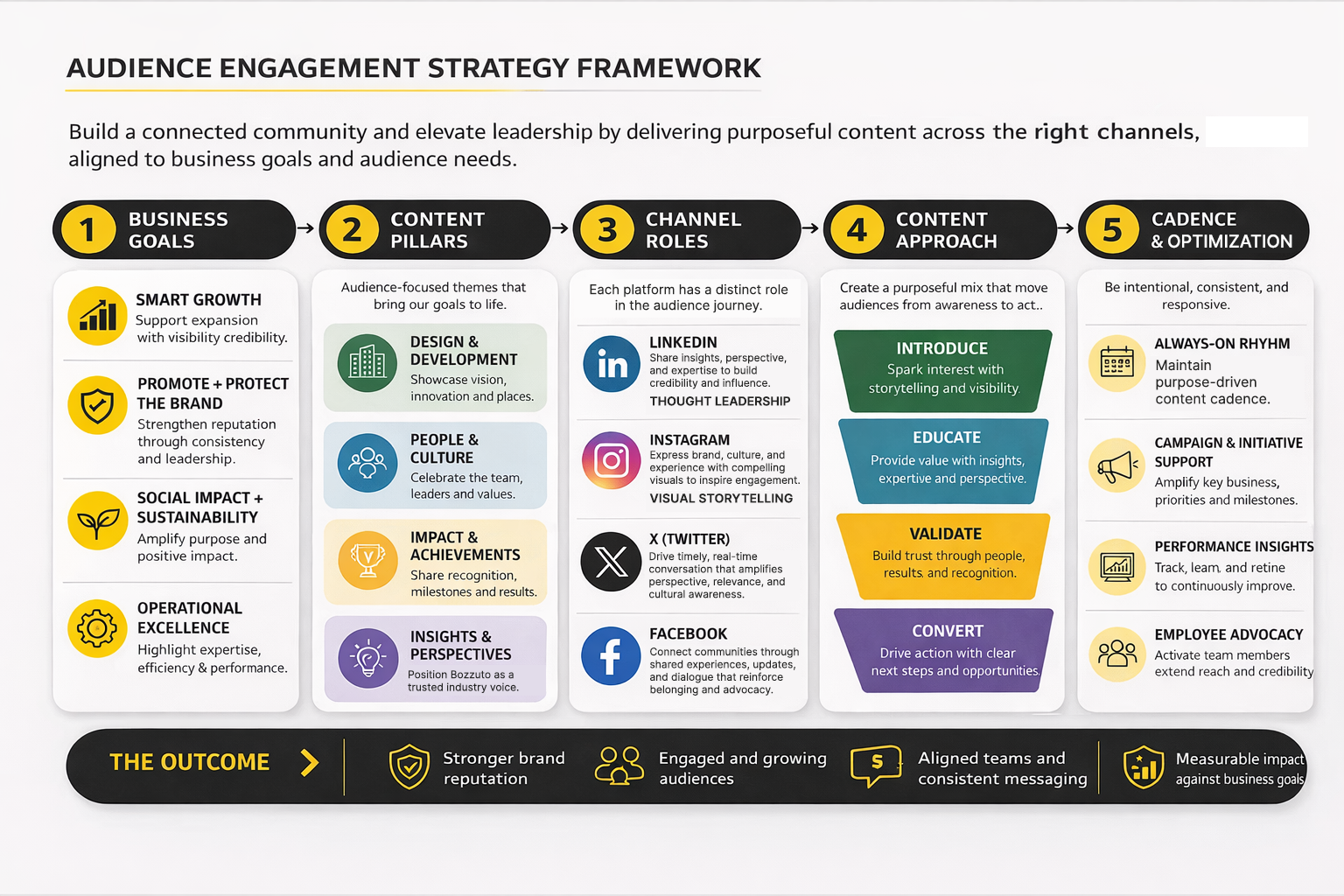
Audience Engagement Strategy Framework
Overview
This work introduces a structured approach to audience engagement, aligning content, channels, and business objectives into a cohesive system. Rather than treating social media as a series of outputs, the focus shifted to designing how audiences interact with an organization over time across digital touchpoints.
The Problem
Content was being produced consistently, but without a unifying system to guide audience engagement.
Channels operated without clearly defined roles
Messaging lacked continuity across the audience journey
Content was driven by calendar needs rather than user intent
Limited connection between content and measurable outcomes
The result was activity without alignment, and engagement without progression.
The Shift
The approach moved from planning posts to designing an engagement system.
Instead of asking what to publish, the focus became:
How should each channel function to influence audience behavior?
This led to:
Defined audience intent across stages of engagement
Clear roles assigned to each channel
Content structured around purpose-driven pillars
Cadence aligned to behavior and timing—not volume
A direct connection between content and business objectives
The Framework
The Audience Engagement Strategy Framework was developed to unify these elements into a repeatable model.
It connects:
Business goals → what the organization needs to achieve
Content pillars → what is communicated and why
Channel roles → where and how engagement happens
Content approach → how ideas are expressed
Cadence logic → when and why content appears
Together, these layers create a system designed to move audiences from awareness to action.
Outcomes
This work established:
A shared language for content and engagement across teams
A scalable structure for planning and execution
Greater alignment between messaging and business priorities
A foundation for consistent, experience-led communication
Artifacts
The following presentation outlines the full strategy, including performance insights, content architecture, and channel-specific execution guidance.
Organic Social Content Strategy Presentation (Client-Facing)